Burning Man, a week long annual event organized by Block Rock City, is held in the Black Rock Desert om Nevada. It is mainly described as an experiment of radical self reliance, self expression, and community. Every year this event gains more popularity, having 51,400 people attend in 2010. Burning man does not focus on one single area, instead there are several main themes to this event, which are: gifting, inclusion, decommodification, radical self reliance, radical self expression, communal effort, civic responsibility, leaving no trace, participation, and immediacy. Once the a ticket is purchased, there are no prerequisites for the attendee, besides participating in a potlatch, bartering, and doing "favors."
I've actually watched a video based on Burning Man and I think it's interesting. It's not the sort of environment I'd like to be in (desert, drugs, nudity), but I do think it is a neat way to allow people to express themselves without being judged. It's sort of like a utopian society.. Only one where many participate in illegal activities. The reason why I approve of this event is because I feel it's an outlet for those people who would appear to be behaving deviantly in our everyday society; that's what Burning Man is there for, nobody judges and it's just like a world of hippies!
Monday, May 16, 2011
Joseph Beuys
Joseph Beuys was a contemporary, sculptor, installation artist, and art theorist born on May 12th, 1921 in Krefield Germany. He acted as a modern shaman and as a catalyst encouraging social change as well as putting emphasis on art using actions, opinions, and personality.
Born on May 12th, 1921 in Krefield Germany, Beuys was the only child of merchant Joseph Jakob Beuys and Johana Maria Margarete Beuys, who were strict Catholics. During Beuys primary school years, his teachers noticed his talent for drawing, as well as musical talents in piano and cello. He also pursued interest in science and chose a career in medicine. In 1940, he joined the military voluntarily, in order to avoid being drafted. He was trained as a combat pilot and aircraft radio operator. During these years of active duty, he was seriously injured various times. As his last years of school approached, rather than pursuing a career in medicine, Joseph Bueys decided to become a sculptor instead. He graduated from school in the Spring of 1941.
Joseph Beuys said much of his interest in fat and felt as sculptural materials developed from his wartime experience, specifically a crash in the Crimea. Although many have reported this story as false, Beuys claimed:
“Had it not been for the Tartars I would not be alive today. They were the nomads of the Crimea, in what was then no man’s land between the Russian and German fronts, and favoured neither side. I had already struck up a good relationship with them, and often wandered off to sit with them. ‘Du nix njemcky’ they would say, ‘du Tartar,’ and try to persuade me to join their clan. Their nomadic ways attracted me of course, although by that time their movements had been restricted. Yet it was they who discovered me in the snow after the crash, when the German search parties had given up. I was still unconscious then and only came round completely after twelve days or so, and by then I was back in a German field hospital. So the memories I have of that time are images that penetrated my consciousness. The last thing I remember was that it was too late to jump, too late for the parachutes to open. That must have been a couple of seconds before hitting the ground. Luckily I was not strapped in – I always preferred free movement to safety belts… My friend was strapped in and he was atomized on impact – there was almost nothing to be found of him afterwards. But I must have shot through the windscreen as it flew back at the same speed as the plane hit the ground and that saved me, though I had bad skull and jaw injuries. Then the tail flipped over and I was completely buried in the snow. That’s how the Tartars found me days later. I remember voices saying ‘Voda’ (Water), then the felt of their tents, and the dense pungent smell of cheese, fat and milk. They covered my body in fat to help it regenerate warmth, and wrapped it in felt as an insulator to keep warmth in."
In other words, during this crash, he was rubbed with fat and wrapped into animal felt by the nomadic tartars who came to his rescue in order to warm his body.
![]() |
| "The Pack" 1969 |
The Pack consists of a Volkswagen bus with 20 wooden sleds, each with a rolled-up felt, leather belt, fat, rope and flashlight. The Story, as it came to be known, wasn't just an inspiration for much of his work, but a statement of his optimistic belief in humanity's ability to survive if only we cared for one another.
Upon his return from the war, Beuys dropped his plans to pursue a career in medicine and enrolled in the Dusseldorf Academy of Art to study sculpture. He graduated in 1953 and focused on drawing (producing thousands in 1950's only), reading, philosophy, science, poetry, literature, etc. During this time, Beuys struggled with the the trauma of his experiences during the war. He explored a large range of unconventional materials and developed his own artistic ideas, leading to the exploration of metaphorical and symbolic connections between natural phenomena and philosophical systems. He was concerned with the representation of animals, which according to him were untouched by civilization and technology. In 1956, Beuys artistic self doubt and material impoverishment led to physical and psychological crisis and he fell into a serious depression. Soon after recuperating from his illness, his work was deeply mysterious and poetic.
![]() |
| How to Explain Paintings to Dead Hare (1965) |
![]() |
| "Homogeneous Infiltration for Grand Piano" 1966 |
Through this artwork, Beuys is telling us (through the title) that the piano is the same functional piano we have seen before, only under this felt (it is homogeneous). Communication for the piano is not currently possible under the felt. If we look at the piano like it’s a person, it becomes easier to understand: when people look into themselves (infiltrate ourselves) we can begin to heal. The healing will release us from the things that restrict our voices and let our creativity and thoughts come into the world unmuffled.
![]() |
| "Felt Suit" 1970 |
Beuys referred to his art as his most effective therapy. He received national and international recognition and there was an exhibition opened in 1979. It has been described and a lightning rod for Americans. Joseph Beuys died of heart failure on January 23rd, 1986. His career was described as passionate and controversial; however, he is now regarded as one of the most influential artists of the 20th century.
Monday, April 25, 2011
BEALL Center for Art + Technology
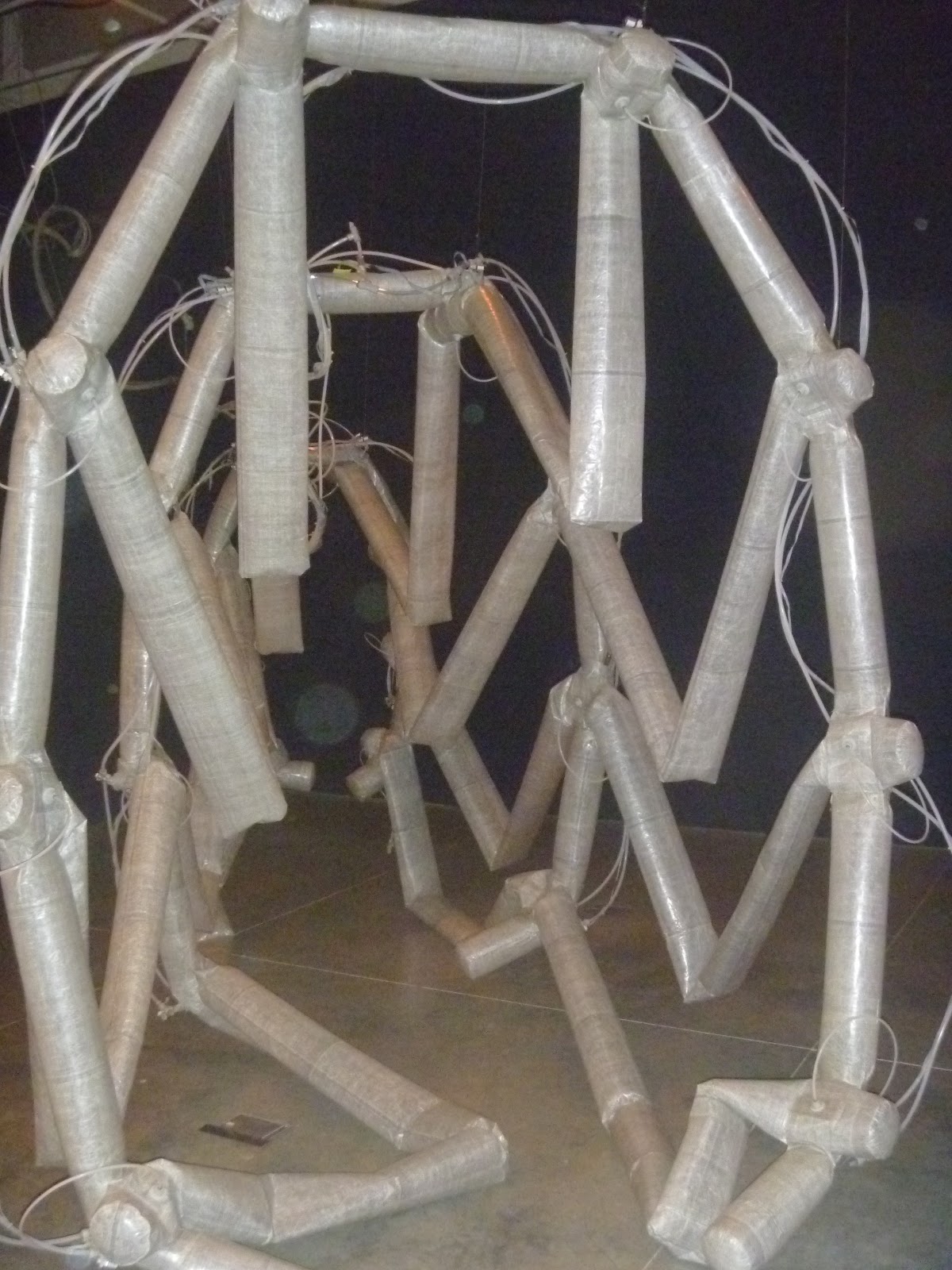
It was a struggle finding this place, along with finding a parking spot. However, I must say it was very well worth it and I truly enjoyed this experience; being able to look at various kinds of art in a small little gallery sort of place was neat. Going in was very dark and mysterious, yet very lovely. Ariah and I were instantly greeted by the inflatable body right in the middle of the inflation process haha. From afar, it didn't seem like such a big deal, but the more I thought about it, the more curious I became. I asked myself, "How can air make something move?" It's just air... But this air does so many amazing things. We watched the body get inflated and uninflated and it was delightful seeing the whole thing happen right before our eyes.
After seeing the first figure getting inflated, we went inside and saw the ballerina legs, before they were inflated. I tried to figure out what they were since they don't look like much without being inflated, but as the whole inflation process began, it became more clear as to what it was. Something that really surprised me was discovering how air's pressure can determine which direction something will go. For example, no pressure leaves the inflatable objects looking dead, maybe even unattractive. However, once the air machines start to do their job, we come to find life in these objects and it's the pressure which makes them look the way they look. The ballerina legs were spread out, yet a few minutes later I began to see how some started to move differently and I realized it was just all pressure. The more pressure they had, the higher and firmer they stood. With less pressure, the lower everything stood. The same thing occurred with the space shuttle thing. When more pressure was added, the inflation process was complete, making it look like a strong, firm shuttle.
We thought the 3 inflatable objects were the only things to look at.. until we "snuck" around and found a door which led us to another room with stuff totally different than what we had seen in the room before. It was actually a bunch of cool random stuff all created by students attending UCI. The following images are things we came across during our visit:
The image above is what we first encountered when we made our entrance. It was in the middle of getting inflated, so watching this happen was very interesting.
The image above is what I call the ballerina legs. Once they got inflated, several of them began going different directions due to the pressure.
The image above was like some sort of space ship. Before getting inflated it just appeared lifeless and I had no clue what it was; however, after the inflation process was complete, I realized this was a space ship.
The image above does not necessarily tell me much, besides the fact that it's not a test, but I just really caught my attention.. Because usually it is a test.
The image above was so cool!! Probably my all time favorite. It was so weird seeing all these magazines floating without a bookshelf and I almost felt like just putting my hand under them in case one of them fell. I remember looking through them and seeing a bunch of Playboy magazines haha.
The image above reminded me of what it's like getting out of the shower and being unable to see myself clearly due to the fog. It made me want to "try" taking the fog off to be able to look at the guy's face. Too bad it was permanent :(
The photographs above were so mysterious. Almost creepy because they reminded me of the movie "The Blaire Witch Project." Also, it was interesting being able to see the room from different angles and it made me wonder what was outside these windows.
Overall, my experience at the BEALL Center for Art and Technology was interesting. Although I cannot say it was my favorite place (LACMA was my favorite), I can say it was very different from stuff I've seen in the past. What I really liked about this place was that the art was created by current or former students. The reason why I liked this so much was because usually, when I've looked at artwork, all of the pieces have been created by some famous artist, one who I will more than likely never get to meet. This place was different, The creators of the art found in this place are not much older than me and it's somewhat inspirational knowing it can be anyone. I would definitely go back and take my family, I'm sure they would get a kick out of the inflatable bodies and much of the art would amuse them.
Tuesday, April 19, 2011
Scott Wade (12)
Scott Wade is an artist from San Marcos, Texas. Instead of using canvas, he uses dirty cars to make art. He's known for making dusty rear windows into masterpieces that only last as long as a stiff breeze allows. A complete art piece of Wade's takes about 2 to 4 hours to complete. Wade is also known as an "earth artist" because he does not use any chemicals in any of his pieces. All he uses is "earthly" stuff, such as dirt and dust.
Wooww Scott Wade is the man! I had no idea it was possible to make something beautiful out of dust and dirt! I also didn't know it was possible to not only make something, but make it look as good as this! It really looks like paper and some high quality pencil were used, but none were! These dirty car paintings look like they'd be worth millions. If I was ever lucky enough to have Wade do something like that on my car windows, I'm almost sure I wouldn't never EVER wash my car again or take it out when it's raining haha. :p
Tony Oursler (11)
Tony Oursler is an installation and multimedia artist born in New York City in 1957. He is known for his fractured-narrative handmadev video tapes including The Loner, 1980 and EVOL 1984.
Oursler's art is very random to me, hahaha. Not the kind of stuff I like to look at on a daily basis, but it is very unique and very different from most of the other artists I've done research on. I wonder where his inspirations came from...
Scott Blake (10)
Scott Blake was born in Tampa, Florida in 1976. He is mostly known for his artwork created by using barcodes to create a bigger image. His work has been displayed at several galleries as well as featured in magazines, like FHM and The New York Times. Blake's barcode use began around the time of the Y2K, which was the time when there was a craze with barcode artwork.
I'm more than sure I've seen Blake's barcode art prior to doing research, but I'm unsure where I've seen it at. After reading about him I realized one thing, art can be made out of anything. A canvas or paint aren't even necessary to create something. Whenever I look at barcodes, I have not once thought about how something spectacular could be created out of them. So crazy!
Joan Jonas (9)
Joan Jonas was born in New Year in the year 1936. She is a pioneer of and performance art and is considered one of the most important female artists ti emerge in the 60's and 70's. She started off as a sculptor and changed her style a few years later. During these years, Jonas also worked modeling mythological heroes like Icarus, as well as studying dance. She mixed performances with props and mediated images.
Hmm Joan Jonas's work was interesting.. Creepy, yet interesting. To be honest, I got nervous watching this video, but I can't put my finger on it. The picture below also scares the hell out of me and I still don't know why.. I'm thinking the black and white has a lot to do with it. No color makes all the art look very mysterious and strange.
Jonas made Vertical Roll, a twenty minute black and white tape; which shows Jonas masked and naked, with her head to the horizontal to the bottom of the roll (of the tape).
Subscribe to:
Posts (Atom)